Know Thyself: What Painting Can Teach Us About Ourselves
While preparing a video about art, I kept asking myself what I could share that might be useful beyond the studio. I could talk about colour, shapes or composition. Yet I kept returning to the person making those decisions.
Why do I pursue one idea and abandon another? What do I mean when I say I want to become a better artist? How do those choices relate to the life I want to live?
For me, self-knowledge through art begins with questions like these. Painting gives me experiences to examine, and sometimes a reason to reconsider what I thought I knew about myself.
What Does “Know Thyself” Mean?
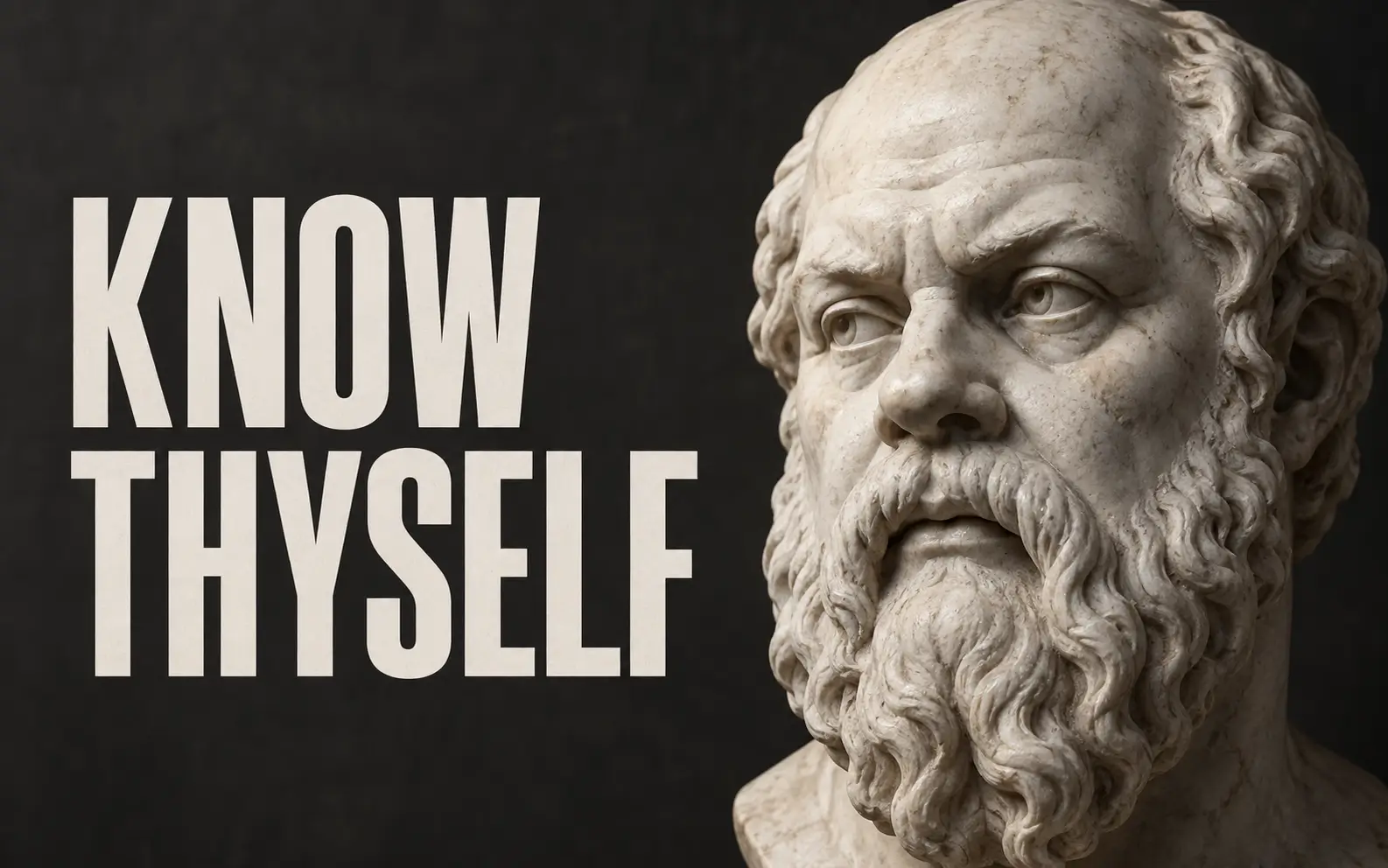
“Know thyself” was inscribed at the Temple of Apollo at Delphi in ancient Greece. Pausanias records it among the maxims dedicated there. Its brevity leaves us with a demanding question: how well do we understand ourselves? Pausanias, Description of Greece 10.24.1.
Ancient discussions also connected self-knowledge with recognising our capabilities. In Xenophon’s Memorabilia, Socrates asks whether knowing our name is enough, then turns to understanding our abilities and their limits. Xenophon, Memorabilia, Book IV, chapter 2.
I find that connection useful in the studio. Recognising what I can do gives me a starting point. Recognising what I have yet to understand gives me something to learn.
Looking More Closely at How We Describe Ourselves
My name is Severino Canepa. I am a painter. My cultural background, experiences and relationships have shaped my life. These descriptions tell you something meaningful about me, while leaving many questions open.
I might also describe myself as patient, curious or kind. Each word becomes more revealing when I connect it to a situation.
If I believe I am patient, how do I respond when a painting takes longer than expected? Does that patience remain when I cannot see a way forward? If I value curiosity, how often do I make room for something unfamiliar?
A description can become more precise through observation. I may be patient with developing a composition and impatient with my own progress. Understanding that difference gives me something concrete to work on.
Socrates and the Practice of Questioning
In Plato’s Theaetetus, Socrates compares his work to that of a midwife. Through dialogue, he helps another person bring a thought into words and examines whether it holds up. This image underlies Socratic maieutics: helping ideas emerge and testing them carefully. Plato, Theaetetus, 149a–151d.
I can borrow this approach when I reflect on my own practice.
Suppose I say that experimentation matters to me. What counts as an experiment? Trying a new colour? Changing the composition? Allowing a shape to develop without deciding its role in advance?
Then comes a more demanding question: do my choices make room for those possibilities?
In the Apology, Socrates also recognises the value of being aware of what he does not know. That willingness to question certainty gives me a useful attitude to bring to these reflections. Plato, Apology 21d.
I can begin with an answer, test it against experience and remain willing to revise it.
What an Unexpected Mark Can Reveal
Imagine that an unexpected mark appears in a painting. It changes the relationship between two shapes, and my first impulse is to cover it.
There may be a good reason to do so. Perhaps it draws attention away from the part of the composition I want to develop. But I can pause long enough to examine that judgment.
Have I really looked at what the mark contributes? Am I responding to the painting as it is, or to the difference between what I expected and what appeared? What might happen if I worked with this change for a while?
The eventual decision could still be to remove it. The pause helps me understand the decision.
One choice tells me little about my whole personality. Across many paintings, however, I may notice patterns: changes I repeatedly resist, familiar solutions I return to, or discoveries that make me want to keep working.
What Does Becoming a Better Artist Mean?
Wanting to improve sounds straightforward until I ask what improvement would look like.
I might want greater skill in organising shapes, more confidence in my use of colour, stronger recognition for my work, or more freedom to explore. These ambitions can coexist, but they ask different things of my time.
If I want to understand composition, I can make studies that change the placement and scale of a few shapes. If I want to explore more freely, I can give an experiment time to develop before deciding whether it belongs in a finished painting.
Self-knowledge helps me connect an ambition with a choice I can actually make. It also gives me a way to ask whether I still want what I have been pursuing.
Learning Through Other People’s Eyes
Reflection becomes richer when I allow another perspective into it.
Someone I trust might notice that I repeatedly change a painting at the same stage. They might ask why I protect a particular shape, or why I dismiss a composition that holds their attention.
Their observation gives me something to consider. I can look again, compare it with my own experience and decide whether it helps me understand a habit.
I also want to notice what is working: the conditions that help me concentrate, the decisions I make with care, and the kinds of discovery that sustain my interest.
A Simple Exercise in Self-Knowledge Through Art
You can begin with a sketch, a painting, a piece of writing or another small creative activity.
- Choose one belief about yourself. For example: “I am curious,” “I am patient,” or “I value experimentation.”
- Explain what you mean. Describe what that quality would look like in an action.
- Recall two experiences. Find one that supports your belief and another that makes it more complicated.
- Try a small experiment. Give yourself ten minutes to explore an unfamiliar arrangement of shapes, a different composition or an idea you would usually set aside.
- Notice your response. What interested you? What frustrated you? What would you like to try again?
Keep the observations specific. “I changed the composition as soon as it felt unfamiliar” gives you something more useful to examine than a broad judgment about your character.
Return to the exercise as your experience grows. Your understanding may become more detailed, and your answers may change.
Giving Attention to the Life We Are Living
I feel fortunate to be alive, and I want to give that opportunity my attention. Painting is one of the ways I do that.
It asks me to make choices, live with uncertainty and remain receptive to what happens. When I reflect on those experiences, I can better understand what deserves my time and what I want to develop.
There is room here for patience with ourselves, too. We can make a decision with the understanding we have today and learn enough to make it differently tomorrow.
The next time you create something, take a moment to notice what guides your choices.
What might this experience help you understand about yourself?