
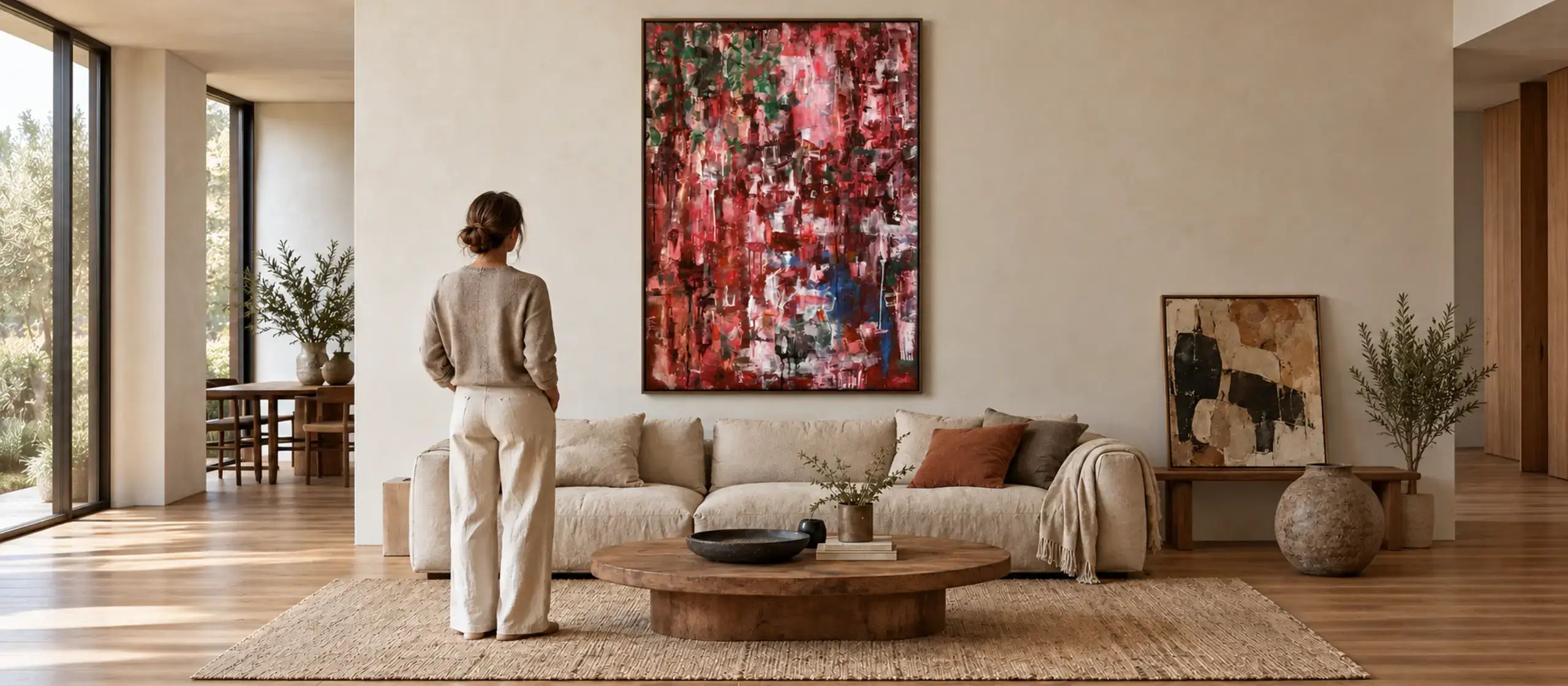
A painting catches your attention. You look at it, move on, then find yourself returning. Something in its shapes, colours or movement stays with you.
Then the questions arrive. Would it work in your home? Is it the right size? Do you understand it enough to buy it?
Learning how to choose art begins with paying attention to that first response. From there, a few practical checks can help you decide whether a work belongs in your life.
Choose art that holds your interest, suits the space where you will experience it, and fits a budget that includes framing and delivery. Take time to understand what you are buying and ask questions before committing.
As an abstract painter, I work with emotions and sensations that resist language. I know how much a painting can communicate before anyone finds the words for it. Your response deserves room in the decision.
Start with what makes you look again
Before searching for a particular style, notice what already attracts you.
Look at paintings, drawings, photographs and prints. Visit exhibitions when you can. Save a small selection of works you would like to see again, then look for connections between them.
Perhaps you respond to open compositions, restless marks, unusual colour relationships or forms that hover between a figure and a landscape.
Try to describe your response in ordinary language:
- Where does my eye go first?
- What makes me want to keep looking?
- Does this work feel familiar, surprising or both?
- What do I notice when I return to it?
You do not need to identify an art movement to recognise a preference. These observations give you a more useful starting point than choosing whatever happens to be fashionable.
Think about how you want to live with the artwork
Consider where you will encounter the piece and what you would welcome there.
In a bedroom, you might enjoy a painting that invites quiet attention. In a living room, you might prefer something that brings energy or starts conversations. Your preferences may work the other way around.
Look beyond the room’s label. Will you see the artwork across a large space, from a reading chair, or briefly as you pass through a hallway?
Colour can connect a painting with its surroundings, but matching every shade is optional. A work might echo the warm tones of wooden furniture or introduce an unexpected contrast into a pale room.
Think about the relationship between the artwork and the room: their colours, proportions, rhythms and differences. A painting can feel at home while bringing something new to the space.
Choose the right size by testing it
Online, a small drawing and a large canvas can occupy the same amount of screen space. Check the measurements before imagining either on your wall.
Make a paper template using the artwork’s dimensions, including the frame if one is supplied or planned. Position it where you are considering hanging the piece, then view it from the places where you normally sit and stand.
Notice whether the proportions feel comfortable, whether nearby furniture crowds the outline, and whether you would prefer more space around it.
A large painting can create an enveloping experience. A small work can reward close attention. Think about which kind of encounter you want.
For a substantial canvas or sculpture, also check access through doors, stairs and lifts, and ask what installation will involve.
Understand the artwork’s medium and format
Read the description closely. Are you considering a unique painting, a drawing, an original print, a reproduction, a photograph or a digital work?
An original print can be an artwork in its own right, produced through printmaking, rather than a reproduction of an existing painting. Prints may exist in multiple impressions. MoMA’s introduction to prints is a useful starting point.
For anything advertised as a limited edition, ask about the edition size, numbering and any additional proofs. For digital art, clarify whether the purchase is a physical print, a file, or another display format.
Then consider what you enjoy about the object itself. Do you want to see painted gestures on canvas? Are you drawn to the intimacy of a drawing or the precision of a photograph?
The format should suit both your interest and the way you intend to display the work.
Set a budget for the complete purchase
Choose an amount you feel comfortable spending, then ask for the full cost before deciding.
Alongside the artwork’s price, check framing, packing, delivery, transit insurance and installation where relevant. For an international purchase, ask whether any applicable taxes or import charges are included.
These practical costs are also highlighted in Artsy’s guide to buying a first artwork.
If a work exceeds your budget, explore smaller pieces, drawings or editions that interest you. You can also wait. A budget helps you make a decision you can enjoy after the excitement of purchasing has passed.
How to choose abstract art
Abstract art can create a particular hesitation: “I like it, but I don’t know what it means.”
Begin with what you can see. Follow the movement of a line. Notice where shapes gather or separate, where colors press against each other, and where the composition leaves room to breathe.
Then pay attention to your associations. A curve might suggest a shoulder. A group of marks might remind you of branches, a crowd or a memory of weather. Another viewer may see something entirely different.
In my own practice, nature and the human body influence shapes, gestures and composition without always becoming recognizable subjects. A painting can carry those connections while leaving its interpretation open.
Read the artist’s statement after spending a little time with the work. It can deepen your encounter and reveal the questions behind the painting.
For me, a useful question is: does this work give me a reason to keep looking? Immediate attraction matters, and so does the curiosity that remains.
Ask questions before buying art online
Whenever possible, see the work in person. If you are buying remotely, request enough information to understand both the image and the physical object.
Useful questions include:
- Can I see a clear full view, close-up details and the edges or frame?
- What are the medium, support and exact dimensions?
- Are there any condition issues or previous repairs?
- What invoice and supporting documentation will accompany the work?
- How will it be packed and delivered?
- What are the terms for returns or damage in transit?
Keep written answers with your purchase records.
A room mockup can help you imagine placement, but confirm that it uses the correct dimensions. Photographs and screens can also affect colour: use several views to inform your decision rather than expecting one image to reproduce every detail.
When buying directly from an artist, ask about the work’s development. Understanding a choice, a change or a discovery can add another dimension to something that already interests you.
Check that the location will protect the work
Before committing to a display location, consider its light, heat and humidity.
Avoid direct sunlight and places exposed to dampness, strong heat or rapid environmental changes. The Canadian Conservation Institute’s guidance on caring for paintings explains how these conditions can damage artworks.
Ask the artist, gallery or a qualified framer for advice suited to the materials. A work on paper and a painting on canvas may need different protection. Check the weight and hanging requirements too.
Choosing a suitable location is part of choosing the artwork: you want to enjoy it and give it appropriate care.
Give your decision a little time
If you are uncertain, return to your shortlist after a few days. Look again before rereading descriptions or checking other people’s reactions.
Which work do you remember most clearly? Which one reveals something you missed? Which would you enjoy encountering on an ordinary morning?
You may find that the most dramatic first impression fades, while a quieter work continues to draw you back. You may also discover that your first choice remains convincing.
Give yourself enough time to recognize the difference.
Frequently asked questions about choosing art
Does art need to match my furniture?
It can share colors, shapes or a sense of rhythm with the room, but an exact match is optional. Try imagining both harmony and contrast, then choose the relationship you prefer.
Can I buy abstract art if I cannot explain it?
Yes. Start with the composition, colors, movement and your response. Learning about the artist’s intentions can enrich your experience without requiring you to settle on one interpretation.
What should I check before buying my first artwork?
Confirm the format, dimensions, condition, documentation, complete price and delivery terms. Make sure you have a suitable place to display it, and ask for more information whenever a detail is unclear.
Find a painting you want to return to
Choosing art gives you an opportunity to notice what matters to you: the shapes you follow, the colors you remember, and the questions you enjoy leaving open.
You can explore my abstract paintings at your own pace. If a particular work stays with you, contact me about the painting to discuss its details and availability.